
Sick of working the 9-5 grind to help make someone else rich? Are you contemplating starting your own business? Do you want to be your own boss badly…
7 Ideas For Starting Your Own Company

The amount of small businesses starting each year is around 400,000 worldwide. Unfortunately most of them fail to launch successfully and the majority close up shop after just a few years. It is not easy for everyone to be an entrepreneur, small business owner, or startup founder. Not everyone is built for it or has the desire, but those with the entrepreneurial spirit have a lot of business options available.
Sick of working the 9-5 grind to help make someone else rich? Are you contemplating starting your own business? Do you want to be your own boss badly…
7 Ideas For Starting Your Own Company
With both Congress and the new administration seeking ways to deliver on their economic promises, this playbook offers a clear path forward.

As the 119th Congress begins its session and a new administration prepares to take office, an innovative partnership between Goldman Sachs 10,000 …
New Small Business Policy Playbook: A Bipartisan Path to Economic Growth
When team members trust each other and feel safe bringing up issues and concerns to their team, relationships between individuals strengthen

Over a decade of working with all kinds of teams, I’ve found the best of the best possess these “team alchemical elements.”
5 ways to demystify the magic of high-performing teams
Bounce has long been a supporter of diversifying the pool of entrepreneurs and small business owners in Akron. Its program GROW, or Generating Real Opportunity and Wealth, which Aspiring Entrepreneurs is a part of, focuses on helping women and minority entrepreneurs.

Similar direction Sublett has been with Bounce since it was founded in 2018. Doug Weintraub has lead the organization as CEO from the beginning and …
Akron’s Bounce Innovation Hub enters new phase of leadership

Retaining top talent should be at the top of a leader’s priority list. Doing so requires engagement, recognition, and caring. Those investments pay …
How Good Leaders Keep Their Top Talent
“Best” is relative when you’re dealing with humans. The most-effective approach is the one that allows for flexibility.

PUBLISHED MARCH 22, 2022 | BY GEOFF GENTRY IN TEAMWORK
5-SECOND SUMMARY
These days, it’s not uncommon to hear people obsessively talking about what “type of leader” they are. People are hungry for resources that will solidify their understanding of these archetypes. But obsessing over finding the right management style can be a dead end; not only are certain methods outdated, but there’s no single tool that will work in every situation.
If you want to build an effective, high-performing team that will stay relevant for years to come, situational leadership is the way to do it.
What is situational leadership?
Situational leadership is an adaptive leadership style in which a leader changes their approach based on the individual, the task, and the context.
Situational leadership theory changes the conversation from “Who am I and how do I lead?” to “Who is the person in front of me, and what do they need from me in order to be successful?”
This theory was developed by Ken Blanchard and Paul Hersey in their book, Management of Organizational Behavior.

Blanchard and Hersey call on the situational leader to utilize a framework that relies on flexibility, adaptability, and thoughtful analysis of what people need to develop and succeed. By letting context inform what an appropriate leadership style looks like in each situation as it occurs, leaders are able to take a nuanced approach to their responsibilities
4 examples of how to use situational leadership
Situational leadership is built on the idea that teams or individuals will be at different developmental levels in different areas of their job. Based on that context, leaders can adjust their approach to help individuals develop specific skills based on that person’s unique needs and area of work.
Situational leadership defines four development levels, paired with four behaviors, as a way of understanding a person’s growth and what is required from a leader to help them move forward. None of these behaviors is the “best,” because all of this is about taking a situational approach. Let’s take a look at each one.
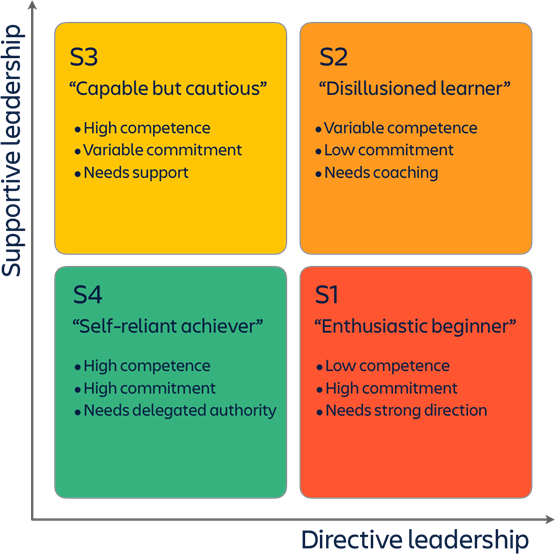
1. The enthusiastic beginner
This is where almost everyone starts when they’re learning a new role or skill. Their commitment is high because there hasn’t been any experience that would challenge it, and their competence is low because they have little-to-no experience.
People don’t know what they don’t know. When an employee or teammate is learning something new, the best leadership for them will be highly directive. They don’t need to be encouraged that they can do it, as much as they need to be told what to do. This isn’t demeaning, it’s just the reality of starting to learn something new.
2. The disillusioned learner
When employees are at the disillusioned learner level, they’ve probably run up against their shortcomings in the competency they’re trying to gain. This experience of failure or inadequacy, coupled with only marginally increased competence, can be incredibly deflating.

As a person is confronted with the shortcomings in their proficiency, the natural reaction is to become discouraged. If you perceive that shift in your direct report, it’s essential that you add highly supportive behavior while maintaining a highly directive posture. The critical mistake leaders make in this stage is to think that because the person has been working at a skill that they no longer need direction. However, this is actually the stage where highly directive behavior is most important.
3. The capable-but-cautious performer
At this level, the employee starts to turn a corner. As their competence increases, often people will start to move out of that low-commitment funk.
This is a critical transition, according to situational leadership theory. As someone’s competence makes meaningful progress and their commitment level increases again, it’s important to scale back the level of direction you provide while maintaining a highly supportive environment.
4. The self-reliant achiever
At this point, the developing employee has reached a point of mastery in the skill they were learning. They can perform at a high level and feel confident about the quality of their contributions.
If a self-reliant achiever is a pro at what they’re doing, inundating them with tons of direction or smothering them with check-ins will most likely backfire. It’s a waste of your time, and takes their focus away from the thing they’ve become really great at. Managers of self-reliant achievers should focus on delegating tasks more than supporting their work.
Good leaders take different behavioral approaches to each of these developmental levels because what each level requires to succeed is different. There is no one-size-fits-all approach to leadership, and you should be suspicious of anyone who claims otherwise.
High-functioning teams are supported by leaders who focus on the practical needs of the people they’re leading and offer support specific to the areas where their team is stuck. Smart managers, practicing situational leadership, give their teammates exactly what they need, when they need it.
 Community Broker News and Views