The secret to people management? Less managing, more peopling

10 powerful strategies to shift your focus from tasks to relationships.

PUBLISHED OCTOBER 21, 2021 IN LEADERSHIP | PRANAV SHAHI VP, Head of IT, Applications

5-SECOND SUMMARY

  • You can’t effectively manage people if you don’t cultivate genuine care for others.
  • As a people manager, you are no longer representing just your individual self. You represent your team and the team’s values and mission.
  • Task management becomes naturally easier if you create a culture of communication and accountability.
  • Putting people first means encouraging them to pursue their aspirations wherever they may lead – even if that means they must leave your team.

Managing people can be a deceptively simple task. Having experience as a “human skilled in craft” doesn’t necessarily make you a natural expert at leading other humans skilled in the same craft. 

Team members interested in becoming managers seem to always ask me the same questions:

  • What did I experience while transitioning to a people-manager role?
  • What have I learned all these years?
  • What would I suggest individual contributors focus on to become better people managers?

Over the last nine years, some of my answers have changed and some have stayed largely the same. However, the most fundamental question aspiring people managers must ask themselves doesn’t appear on the list above.

Do you care about people?

I still remember February 2012. I’d finally found the courage to ask Archana Rao, my then-manager at Cisco (and Atlassian’s current CIO), what it would take for me to become a people manager.

“I see you to be really good at your craft and work,” she told me. “But are you good with people? Do you care about people? Or do you just want the title for other reasons?” 

Her unvarnished honesty caused me to pause and think. If I wanted to be a leader, it wouldn’t be enough to care about the success of a project or the company, or even my own success. I would need to care about the people who depended on my leadership for THEIR success.

My people-management strategies and principles

Here’s how I channel the philosophy of that long-ago conversation into my current management practices.

1. Be a decision SHAPER, not a decision maker

After experimenting with with this idea over a few years, I have realized that teams work well when you invite them to shape a decision, not when you make a decision for them. This is one of the most important principles to me.

When I was studying at Stanford University, I learned about the “IKEA effect” as it relates to problem-solving. Like the affinity and attachment many harbor for the IKEA furniture they construct themselves, I learned that involving others in the decision-making process leads to the solution becoming their “baby.” Or put another way:

If you build a polished prototype others will see flaws. If you build a rough prototype, others will see potential.

Professor Baba Shiv, Stanford University

Shaping a decision involves asking the right questions and sharing examples and guidance – but not giving the answers. It may take time to get to the decision, but this approach improves the likelihood of the decision sticking, which, in turn, reinforces honoring commitments. 

You can apply this in-person or through a DACI decision-making framework.

With decision-shaping, you’ll see that your team will begin to think about the impact not only on them, but on downstream teams, too. A good people manager will allow team members to arrive at the best decision, while being constructively critical in offering analysis and recommendations toward the decision.

Do note that my approach is centered on cultivating and motivating a team to arrive at a decision, not on manipulating them to make a decision I may favor.

2. Create a culture of accountability

Take every opportunity to promote accountability. While this takes effort to instill and reinforce, it will ALWAYS lead to improved trust and performance.

Back when I was a newbie people manager, I felt very uncomfortable when team members didn’t meet deadlines. Then, I would do their work in order to not let the stakeholders down.

The problem was obvious to my management coach who said, “Pranav, I understand it helps the stakeholders, but your team members are not learning to be accountable. Your role is to clear roadblocks, manage risks, and find the resources your team needs to manage its commitments.”

It actually took time to get used to NOT jumping in! What helped me make the transition was an accountability model that I set up for my team. I decided that, as a team, we needed to agree on being accountable. I developed the following rules that were easy to follow:

  • Think thoroughly before committing to a project and its dates.
  • Once you’ve committed, HONOR your commitments (or renegotiate the commitments if circumstances change).

I also discussed the attitudes and behaviors I expected. These open conversations led to less resistance from team members, while allowing them to demonstrate respect for each other.

3. Focus on people over tasks

Placing people over tasks not only results in better professional relationships, but powerful personal connections that can make work more meaningful – and even lead to strong friendships outside of work.

I learned to make an extra effort to know the individuals on my team as human beings, not just employees. We have regular 1:1’s and periodic lunch or coffee meetings. We even took walks when we were working in the office, which helped to promote relaxation and better communication on both sides.

I also became a better speaker by trying not to sound like I was complaining all the time.

But most importantly, I became a better listener.

By listening more, I found myself smiling more, and I felt genuinely interested. In short, I began to care more for what other people had to share! And I spoke a lot less about tasks!

4. Not everything will make it to production

Be sure your entire team understands the reason if a project doesn’t launch. They don’t need to agree, but they do deserve to know why.

Not all efforts lead to successful business outcomes. Priorities change, required efforts may have been underestimated, budgets get tightened, key skill-holders leave, or the anticipated ROI or business case can be incorrect.

This can negatively affect the team. Everyone likes to see their hard work result in something completed, no matter how minor. The antidote is to help your team understand WHY a project didn’t make it to production.

The best example I can share is from earlier in my career when I was still an IT architect. I worked on an initiative for multiple quarters with 50 other team members. It was bleeding edge, we’d already spent more than $10 million, and it was the heart of the project.

During testing, we realized a key element was not going to scale. Imagine the dread we faced. I was particularly affected because it was the first time I had to “pull the plug” and let a project die.

But as we were shelving it, we learnt that if we had not cut the cord, the initiative would have cost more than $10 million PER YEAR to maintain due to this major flaw. The lesson learnt was: a little pain now is worth avoiding much more later.

5. Saying no is ok, but…

One of the most frequent pieces of advice I have shared with newbie managers is that it’s OK to say no. But be prepared to share your logic.

One of my first 360-feedback sessions as a newbie manager revealed that while I was comfortable saying no, I was failing to provide reasons to team members and stakeholders. The result was they could not understand and appreciate my decisions. This affected trust!

Some managers feel threatened when they have to explain. But non-transparency generates questions about a manager’s leadership.

If necessary, try to write down your reasons. In fact, if you can’t write them down, perhaps you aren’t being thorough enough before saying yes or no.

6. “I” is “WE” now

As a people manager, you are no longer representing your individual self. You are now symbolic, representing your team and the team’s values and mission. It’s a great responsibility to be the embodiment of your people, their contributions, and their successes and failures.

We all hear that politics in the workplace is bad, but I’ve learnt that there is a difference between “Politics” – with a capital P – and “politics.”

Politics with a capital P, to me, means “organizational interests.” Whereas politics with a lowercase P can mean “self interest.”

As people managers, we have a duty to move away from the politics of self interest to the Politics of organizational interests.

People managers have to build the right guardrails for team success and, at the same time, be ready to own the effects of all the positive and negative outcomes. You are your team’s shield and banner.

So when you’re required to make decisions, you’re making them as a symbolic reflection of the team, its culture, and its values.

7. Be natural in your style

Aside from playing to our natural strengths, being natural in style is important. It takes less energy to be your true self than to appear as someone you’re not. And being natural can help you be vulnerable, which is an important leadership trait.

We all have natural strengths. I urge newbie managers to recognize theirs.

To stay in touch with my natural strengths, I use 360 feedback with my team, peers, and stakeholders. I  also supplement feedback with psychological assessments like Instinctive Drives (my ID is 6337).

I’ve learned to be so comfortable sharing my areas of improvement that I’m OK asking for feedback and help with a behavior I may not want. Most importantly, I try to make these changes part of my subconscious way of working so that my natural style isn’t disrupted.

You will be more comfortable with all your team engagements by being natural, and it will definitely help you be sincere and honest when you have hard conversations.

8. Hire unconventional talent

Aside from traditional candidates with requisite technical skill sets, I also seek teammates who may not fit the traditional mold but who bring a growth mindset – they demonstrate curiosity, they’re open-minded toward industry breakthroughs, and have an eagerness to innovate – even if their technical skills need development. 

As I see it, the rapid pace of technological change means we need some team members who are more versatile, have non-traditional viewpoints, and aren’t hyper-focused on a particular technology “religion.”

The additional energy and learning curves to get an unconventional new hire up to speed often  prove to be worth the investment, and can yield a huge positive impact with respect to diverse viewpoints and out-of-the-box problem solving.

9. Attrition will happen

Sometimes you will not be able to support your team members’ career aspirations. Other times, they may simply need a change in challenge and work culture. Do not take these things personally.

If you’re putting people first, then you’re also encouraging them to pursue their aspirations wherever they may lead. If they are ready to move on, do your best to help them with internal mobility. This also aligns with being capital-P Political. Consider how their aspirations might align with the organization’s interests.

10. Celebrate failure

Create conditions so that team members feel open to making mistakes and admitting vulnerabilities, with the intention of turning mistakes into opportunities for group learning. Then CELEBRATE!

In a culture like Atlassian’s that strongly encourages risk and innovation, I cannot stress celebrating failure enough.

The best way to instill this principle is by talking about your own mistakes in detail and what you have learned.

While it helps to exploit current strengths, it is equally important to explore new things, make mistakes, and learn from them. Share stories of failure and discuss what the group learned. In fact, find a way to celebrate failures by celebrating whatever risks and innovations come out of the effort.

All failures qualify. It can be a failed experiment, a failure in hiring the right talent, even operational failures that require you to work hard for the cause and the fix.

To scale and become a high performing team, you not only need caring and sharing, you need daring. And all dares come with a huge chance of failure. Get comfortable with that.


Is situational leadership the best leadership style?

“Best” is relative when you’re dealing with humans. The most-effective approach is the one that allows for flexibility.

PUBLISHED MARCH 22, 2022 | BY GEOFF GENTRY  IN TEAMWORK

5-SECOND SUMMARY

  • Situational leadership takes a contextual approach to leadership.
  • In this model, leaders vary their approach based on an individual’s level of competence in a particular area.
  • Depending on the circumstances, a leader may choose to take a more directive or more supportive approach.

These days, it’s not uncommon to hear people obsessively talking about what “type of leader” they are. People are hungry for resources that will solidify their understanding of these archetypes. But obsessing over finding the right management style can be a dead end; not only are certain methods outdated, but there’s no single tool that will work in every situation.

If you want to build an effective, high-performing team that will stay relevant for years to come, situational leadership is the way to do it.

What is situational leadership?

Situational leadership is an adaptive leadership style in which a leader changes their approach based on the individual, the task, and the context.

Situational leadership theory changes the conversation from “Who am I and how do I lead?” to “Who is the person in front of me, and what do they need from me in order to be successful?”

This theory was developed by Ken Blanchard and Paul Hersey in their book, Management of Organizational Behavior.

Blanchard and Hersey call on the situational leader to utilize a framework that relies on flexibility, adaptability, and thoughtful analysis of what people need to develop and succeed. By letting context inform what an appropriate leadership style looks like in each situation as it occurs, leaders are able to take a nuanced approach to their responsibilities

4 examples of how to use situational leadership

Situational leadership is built on the idea that teams or individuals will be at different developmental levels in different areas of their job. Based on that context, leaders can adjust their approach to help individuals develop specific skills based on that person’s unique needs and area of work.

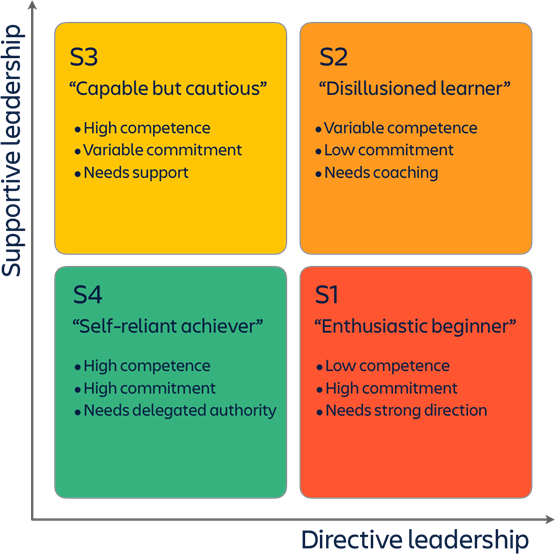
Situational leadership defines four development levels, paired with four behaviors, as a way of understanding a person’s growth and what is required from a leader to help them move forward. None of these behaviors is the “best,” because all of this is about taking a situational approach. Let’s take a look at each one.

1. The enthusiastic beginner

This is where almost everyone starts when they’re learning a new role or skill. Their commitment is high because there hasn’t been any experience that would challenge it, and their competence is low because they have little-to-no experience.

People don’t know what they don’t know. When an employee or teammate is learning something new, the best leadership for them will be highly directive. They don’t need to be encouraged that they can do it, as much as they need to be told what to do. This isn’t demeaning, it’s just the reality of starting to learn something new.

2. The disillusioned learner

When employees are at the disillusioned learner level, they’ve probably run up against their shortcomings in the competency they’re trying to gain. This experience of failure or inadequacy, coupled with only marginally increased competence, can be incredibly deflating.

As a person is confronted with the shortcomings in their proficiency, the natural reaction is to become discouraged. If you perceive that shift in your direct report, it’s essential that you add highly supportive behavior while maintaining a highly directive posture. The critical mistake leaders make in this stage is to think that because the person has been working at a skill that they no longer need direction. However, this is actually the stage where highly directive behavior is most important.

3. The capable-but-cautious performer

At this level, the employee starts to turn a corner. As their competence increases, often people will start to move out of that low-commitment funk.

This is a critical transition, according to situational leadership theory. As someone’s competence makes meaningful progress and their commitment level increases again, it’s important to scale back the level of direction you provide while maintaining a highly supportive environment.

4. The self-reliant achiever

At this point, the developing employee has reached a point of mastery in the skill they were learning. They can perform at a high level and feel confident about the quality of their contributions.

If a self-reliant achiever is a pro at what they’re doing, inundating them with tons of direction or smothering them with check-ins will most likely backfire. It’s a waste of your time, and takes their focus away from the thing they’ve become really great at. Managers of self-reliant achievers should focus on delegating tasks more than supporting their work.


Good leaders take different behavioral approaches to each of these developmental levels because what each level requires to succeed is different. There is no one-size-fits-all approach to leadership, and you should be suspicious of anyone who claims otherwise.

High-functioning teams are supported by leaders who focus on the practical needs of the people they’re leading and offer support specific to the areas where their team is stuck. Smart managers, practicing situational leadership, give their teammates exactly what they need, when they need it.

How to Buy a Business

Ellen Chang 

FEB 12, 2019

So you want to be a business owner, but the prospect of starting your own business is intimidating. One potential solution: Buying an existing business. An existing business typically has customers, vendors and branding already in place. A good company will also have an adequate amount of inventory. That means you can take the key and continue the business without having to build supplier relationships from scratch.

This isn’t an easy route to entrepreneurship, though. Buying a business can be a complicated and arduous process, so you need to know what you’re getting yourself into. Here’s what you need to know.

Buying a Startup

If you’re an existing business owner who wants to expand your services or products, consider buying a startup. You can purchase a startup for its client list, brand, technology or intellectual property.

There are a lot of good reasons why buying a startup might be a good idea for a current business owner:

  • Buying a startup can help you attract and retain a different demographic without starting from scratch. 
  • The startup might have a distribution method that is a good fit for your own business.
  • While the profit margin of a startup tends to be lower than an established business, it might also have less debt. 
  • A small startup might be more nimble and able to adapt to change.

If you decide to go this route, take a close look at current staff. Look for businesses who have founders or staff with the type of talent that you are seeking. While you can always poach talent, buying a business could allow you to acquire a team that already works well together and is invested in the mission of their business.

Keep in mind that if you need to finance, startups present their own set of challenges.  Obtaining a loan for a startup business can be harder, since it would not have as long a track record as a business that has been operating for a decade. The startup might not even be profitable yet, and you might need to demonstrate a path to profitability or show how it will contribute to your own company’s bottom line.

Purchasing an Existing Business

If an existing company better fits your needs, look for one that has a good reputation, a steady list of customers and low operating expenses. Understand, though, that buying an existing business means doing a lot of due diligence. Here are some things to look out for:

  • The founder or owner will likely downplay any issues with a landlord or customers. Ask plenty of questions and ask for documentation.
  • Examine several years of its financial information and focus on how much profit it generated. Also look at its cash flow, debt levels and other expenses such as rent, marketing and advertising.
  • Determine if the owner plans to stay on or has any children who expect to take over a portion of the business. Hammer out all the details beforehand.
  • Acquiring an existing business might be more costly, especially if prior investors are involved. Consider whether you are willing to seek additional investors and take on a bank loan.

Above all, make sure you go into things with an understanding of what’s made the business successful. Buying an existing retail shop or restaurant might be easier than starting one from scratch, but remember that if you change the direction or tone of the business, the existing customers may not accept the changes readily. Further, radical changes to the business and its operations could alienate existing employees. Put your own imprint on the business and find ways to improve, but tread carefully.

Buying a Franchise

A franchise is in many ways the ultimate ready-made business. The brand is already established, and your involvement in marketing may be minimal. Certain aspects of its operations may be set in stone. If you take over a restaurant franchise, for instance, everything from the supply chain to the menu will likely be fixed.

Conducting due diligence on these businesses can often be easier, too. They have a longer history, more financials and other investors. If it’s a public company, it will be even easier to find key information on the business and its financials.

There are some decisions to make, however. You must decide if you want to buy a franchise in a new or existing location. Finding the right location will take time, and requires some research to ensure adequate foot traffic. And don’t assume that the branding and marketing will take care of themselves. While large franchises have a recognized brand, some of them are only well-known in certain states or regions of the country. Consider carefully whether this is a business and a brand with staying potential in your area.

One major issue with a franchise is the loss of control. You must adhere to its rules, procedures and other standardize practices. That might be a relief to some would-be owners, but others might chafe at it. Determine if you’re an entrepreneur at heart or merely want to purchase a business which generates a healthy profit.

Disadvantages

Even if a startup or existing business is highly profitable or popular, there are some disadvantages. In most cases, you will have to retain its current employees at least for the short-term. Turning over an entire staff is not a good choice fiscally or operationally. Don’t underestimate the value of institutional knowledge, to say nothing of the impact on morale of mass layoffs.

On the other hand, existing staff might be resistant to any changes you want to make. The employees may also not like new ones that you hire. And any changes that you make toward the pay structurebenefits and other human resources issues could face resistance. Assure your employees that you are going to stay in business and will not make drastic changes. The same is true for its board of directors and its investors.

Problems could also arise with your customers, clients and vendors. They likely have certain expectations of the business: The products it sells, its methods for doing business, and the length of billing cycles.

Decide before you purchase the business whether you want the CEO or founders to stay on to provide a smooth transition or if you want them to resign soon after the deal closes. There is no right or wrong answer to this issue. It depends on your goals for buying the business, as well as your personal preferences.

Before you sign a contract, consult and hire a business broker who can help guide you in the process. This process can take several months or longer and you will likely need the assistance of an auditor and lawyer. You will likely also need to employ the services of an accounting firm specializing in mergers and acquisitions. 

More Tips for Business Owners

People who own businesses also need to conduct their personal finances differently. Your taxes become more complicated, for one. Your budget and overall financial plan will also become more complicated than if you had an ordinary full-time job. That’s why many business owners choose to work with a financial advisor who specializes in these issues. We recommend using this financial advisor matching tool. Just answer some questions about your finances and goals, and the tool will match you with up to three advisors in your area.

Photo Credit: ©iStock.com/shapecharge, ©iStock.com/skynesher, ©iStock.com/valentinrussanov

ELLEN CHANG

The Power of Micro-Innovations

The Power of Micro-Innovations

Britney Cole / 

When we think of innovation, people like Thomas Edison, Henry Ford, and Steve Jobs tend to come to mind. The lone hero in solitude has a hold on our imagination, but the truth is that innovation is rarely the result of an inspired genius toiling away in a garage.

Groundbreaking innovation takes lots of people. Consider that more than 1,000 engineers worked on the first iPhoneMore than 7,000 people worked on Curiosity (the rover on Mars). The takeaway? Innovation is a team sport.

Innovation doesn’t have to be splashy either. Call it micro-innovating. In fact, small and incremental changes can have an oversized impact on your work life. When to innovate? Anytime you feel your work isn’t serving the greater good. Micro-innovation can be extraordinarily powerful.

So how best to micro-innovate? Let’s take a closer look at what gets in the way of doing it and how you can harness your power.

Micro-Innovation Killer #1: To-Do Lists, Tunnel Vision, No Vision

A typical day: Most of us create a to-do list and strike items as we finish them. I know I personally feel a sense of completion and satisfaction when I click my task off my calendar. To-do items can become so ingrained in our routine. At its worst, checking off items becomes mindless, and we don’t even think about it. When that happens, our to-do lists have more meaning than the tasks themselves. Over time, the work loses significance, and we question why we do the things we do in the first place. Our perspective narrows and our thinking becomes siloed.

Purpose? Process improvement? Innovation? Forget about them because we’re so focused on completing a task—even if the task no longer serves a need. It’s easy to have tunnel vision and wear self-created blinders. And to be fair, we must make so many decisions in our personal life, it’s easy to turn it off at work. But, when our work is filled with tasks, we lose sight of our larger goals.

Micro-Innovation Killer #2: Fear Kills Creativity

Recently, I was speaking to one of my peers, a manager of individual contributors. She manages the leadership development at a large company and was making some updates to a program. She had asked one of her people for their honest opinion, wondering what they might change and how they might improve it. She loved the suggestions and wondered why the person didn’t share these great ideas sooner. The answer was disarming. The individual assumed that the choices were made for a reason and who was she to question those choices. She did not feel empowered to share her fresh perspective; there was no psychologically safe space to share her opinions.

How many people remain silent because of a fear? The majority. In fact, McKinsey found that just 26% of leaders create psychological safety for their teams. Where there is fear, there is little innovation.

Five Tips for Micro-Innovating

Innovation is one of those words that can be intimidating. But it’s inherent in our nature—or else we’d still be living as hunter-gatherers. We are attempting to improve our lives every day and innovate in the smallest ways. Whether it’s preparing meals on a Sunday before a busy work week, optimizing schedules with a planner app, using Microsoft Teams or Slack instead of email, we are always trying to improve our status quo.

Here are five tips to ignite your creative spark and start micro-innovating.

1. Give others permission to speak: Those ubiquitous “If you see something, say something” signs in the airport are relevant for innovating. A leader’s job is to make sure their people feel safe to say, “This task doesn’t feel helpful to what we are trying to achieve. I’d like to understand more about the importance of the task to the overall process—what do you see that perhaps I’m missing?” 

Don’t expect your people to have an answer at the ready—and be clear that it’s okay they don’t have one. Pointing to areas of improvement is NOT complaining! They may not know how to fix the situation, but they have at least diagnosed that something needs improvement. They have ‘seen something and said something.’ And that can short-circuit a potential problem before it becomes a monumental one.

2. Ensure systems exist for people: Processes are supposed to streamline tasks, but often they become workplace handcuffs. When a process creates unnecessary administration or you get hints of malicious compliance, it’s time to rethink the process and suggest ways to streamline. Ask yourself these questions: “What are we trying to solve with this process? Are these actions having the desired impact on the experience we want to achieve? Does the system support us and the customer or slow us down?”

3. Always be learning: Innovation requires experimentation. This also means the willingness to fail. We learn through mistakes, bumps in the road, misalignments. It’s where we improve how we work together and how we meet the needs of our customers/business. The words of Thomas Edison, on the painstaking task of inventing the lightbulb, are a good reminder: “I have not failed. I’ve just found 10,000 ways that won’t work.” 

You can speed innovation by having a learning mindset. Ask your people: “What do you see that I’m missing?” Then remember the iPhone and how it was an iterative invention driven by thousands of people. It takes time and patience. So be easy with your people and yourself.

4. Adopt the right mindset: Throw away your preconceived notions about innovation and focus on fostering a culture of innovation for yourself and your team. Be mindful of your emotional reactions and others by pausing before you respond. Be curious and open-minded and you will bring in multiple perspectives. Have courage to push through your fear of failure. Be resilient to overcome challenges you will face while converging and diverging along the innovation process.

5. Take needed downtime: Ever take a shower and a great idea comes while you’re shampooing your hair? Ever wake up in the middle of the night with a “eureka” moment? The brain needs downtime. When it gets a break, it can make new connections and serve up inspirations. So instead of relentlessly hammering away at the task, take a purposeful break. See what brilliant ideas spontaneously arise.

Micro-innovation is something for the ambitious and courageous. It requires the willingness to be wrong; to fail; to be resilient. All this can be humbling. And it likely will undermine your self-confidence at times. But what’s the alternative? Doing the same old thing over and over—even if it’s no longer useful.

Ready to rally your self-confidence, resilience, and fearlessness to create a small revolution?

Cash vs. Accrual: Which Accounting Method Is Right for Your Business?

Precise accounting is a critical component of running a successful business. There are two primary accounting methods you can use as a small business…

Cash vs. Accrual: Which Accounting Method Is Right for Your Business?

The accounting method you choose for your business is ultimately a management decision, but it also depends on the resources you have, your business goals, and your organization’s financial requirements.

Eight Market Trends for Today’s Small Businesses — Nu Leadership Revolution Blog

With the uncertainty across the globe including the lingering impacts of COVID, many organizations must rethink their business strategies. 

Farewell to the 2020 and 2021 years! If you think 2022 will get us back to normal, I bring you bad news. I’m sorry to tell you that you are in error! Today’s small businesses must take a ‘wait and see’ attitude for 2022, because it is riddled with uncertainty and unpredictability about the future. […]

Eight Market Trends for Today’s Small Businesses — Nu Leadership Revolution Blog

Company mergers and acquisitions boomed at record pace in 2021: study — NYC Daily Post

Middle-market companies and private equity firms foresee an extremely strong year for the M&A market in 2022, with bullish forecasts for both deal volumes and for company valuations, according to a Citizens survey of 400 leaders at U.S. middle-market companies and private equity firms.

[ad_1] Companies bought and sold each other at a record pace in 2021, with 1,047 deals — each valued at more than $100 million — inked globally last year, according to a new study. And researchers say they don’t expect the mergers-and-acquisitions activity to slow down anytime soon. Last year’s M&A boom is the largest […]

Company mergers and acquisitions boomed at record pace in 2021: study — NYC Daily Post