The Self-Aware Leader: Take an Inside-Outside Approach

Can someone be a great leader and not be self-aware? I believe all great leaders are self-aware. If you don’t know how your behaviors affect others, …

The Self-Aware Leader: Take an Inside-Outside Approach

When you know the affect you have on others and how they perceive you, you can entertain different perspectives of a situation. You can be an inspiring leader. You are in a place of choice.

Leadership Development

Exploring Johari Window as a tool to improve self awareness. This overview posted on Sarah’s blog describes the four panes.

In the terms of learning how group therapy works in the field of art therapy, it is understood that personalities vary through the individuals in the group you are working with. Getting to know your group and building a relationship with the individuals is one of the main priorities in group therapy. The Johari Window is a model to guide the art therapist to notice different aspects of their individuals and can also help the individuals in realizing areas of themselves that need more assistance than others.

The Johari Window consists of four main “Selfs” or “Areas.” They are labeled Public Self/Open Area, Blind Spots/Blind Area, Hidden Self/Hidden Area, and Unconscious Self/Unknown Area. Each self is different in which what they keep to themselves and reveal to the world. Using the Johari Window is promoting self-awareness and guiding the group be aware of themselves and parts who they are.

Johari-Window

  1. Public Self/Open Area – area of the indvidual that is known to themself and others around them. For example, a teenage boy who is aware of his anger problems and knows that others are aware of this too.
  2. Blind Spots/Blind Area – a part of the individual’s personality that others only see but the individual does not notice. For example, a teacher who thinks they present a happy persona, but students see that he/she gives off a mean or scary vibe. The teacher has no idea that she presents a mean persona, but her students do.
  3. Hidden Self/Hidden Area – only the individual knows about this aspect, they do not reveal it to others. For example, a depressed teen who sulks and cries when she is by herself in her bedroom because she does not want to present her feelings in front of others.
  4. Unconscious Self/Unknown Area – this is a part of the individual that absolutely no one knows about or notices. For example, an individual uses an unhealthy coping mechanism without noticing that it is unhealthy and others do not realize that is unhealthy as well.

I never heard of this model beforehand and found it to be extremely helpful. The Johari Window can not only be used when working with groups, but even in self evaluating. This model is one of the few things that can be used for yourself and for clients as well in art therapy. Versatile models like these are so helpful and really eye-opening.

Featured Image: [http://cpmagazine.net/september-is-international-self-awareness-month/]

wherecreativityworks.wordpress.com/2018/11/09/johari-window/

10 Simple Things You Can Do For Your Team Today to Make Their Day Better

Helping your team feel good each day is a role every leader should play. It doesn’t have to be a big thing or complicated. Sometimes the easiest actions can be the most important in helping to create engagement and make each day a little better for everyone. Here are some simple ideas for you to try.

10 Simple Things You Can Do For Your Team Today to Make Their Day Better

https://effectiveretailleader.com/10-things-make-their-day-better/
— Read on effectiveretailleader.com/10-things-make-their-day-better/

Coaching, Training or Mentoring

Good overview centered on people development. Effective leaders demonstrate and use these skills to drive employee performance and engagement.

nathanwood.consulting/2017/12/04/the-differences-between-training-coaching-and-mentoring/

https://nathanwoodconsulting.files.wordpress.com/2017/12/development-styles.png

Best Father’s Day BBQ recipe EVER – seriously you have to try this!

If you are celebrating in your community this Father’s Day weekend surrounded by family and friends around the barbecue, you’ve got to try this awesome BBQ recipe.  Its quick and easy, and very tasty.  Thanks to our friends at Epicurious and the Bon Appetit test kitchen, this one is a real winner!

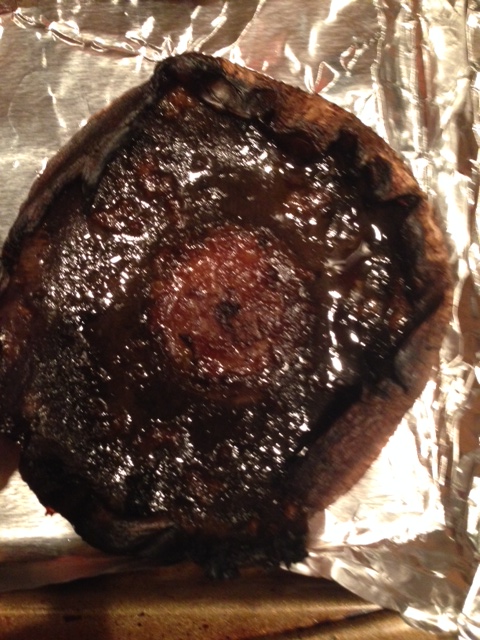
ImageImage

Grilled Portobello Parmesan
by The Bon Appétit Test Kitchen
Bon Appétit | August 2009
Yield: 6 servings
Active Time: Prep: 35 min
Total Time: Total: 40 min

Why stick with chicken or eggplant? Portobello Parmesan is just as tasty—and it doesn’t need any breading. Choose mushrooms that are fresh (you’ll know because they’ll still be curled up around the edges). Older ones are flat and won’t hold the filling as well.

Ingredients

  • 6 tablespoons extra-virgin olive oil
  • 3 tablespoons balsamic vinegar
  • 1 large garlic clove, pressed
  • 6 large portobello mushrooms, stemmed, gills scraped out
  • 1 cup whole-milk ricotta cheese
  • 1/2 cup plus 6 tablespoons finely grated Parmesan cheese
  • 3 tablespoons chopped fresh basil, divided
  • 6 1/3-inch-thick heirloom tomato slices (from 2 very large tomatoes)
  • 7 to 8 ounces Fontina cheese, thinly sliced

Preparation
Prepare barbecue (medium-high heat). Whisk extra-virgin olive oil, balsamic vinegar, and pressed garlic clove in small bowl. Season dressing to taste with salt and pepper. Arrange portobello mushrooms on rimmed baking sheet, gill side up. Sprinkle with salt and pepper. Spoon generous tablespoon dressing into each mushroom; swirl to coat. Stir ricotta cheese, 1/2 cup Parmesan cheese, and 2 tablespoons chopped fresh basil in small bowl to blend. Season to taste with salt and pepper. Arrange tomato slices on plate; sprinkle with salt and pepper.

Image
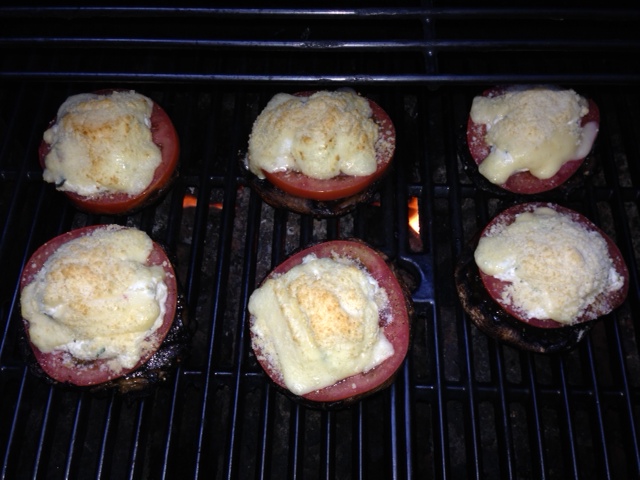
Place mushrooms on grill, gill side down. Grill until edges begin to soften, 3 to 5 minutes, depending on thickness of mushrooms. Transfer mushrooms to same baking sheet, gill side up. Nestle 1 tomato slice into each mushroom. Divide ricotta cheese mixture atop sliced tomatoes, spreading to cover, about 3 tablespoons per mushroom. Top with Fontina cheese slices, dividing equally. Sprinkle 1 tablespoon Parmesan cheese over each. Carefully return mushrooms to grill. Cover barbecue and cook until mushrooms are soft and cheese is melted, about 5 minutes. Sprinkle remaining chopped fresh basil over. Place mushrooms on plates. Drizzle remaining dressing around mushrooms and serve.

HAPPY FATHER’S DAY DAD!

Nutrition Information
Per serving: Calories (kcal) 375.4, % Calories from Fat 69.6, Fat (g) 29.1, Saturated Fat (g) 12.7, Cholesterol (mg) 70.0, Carbohydrates (g) 6.1, Dietary Fiber (g) 0.6, Total Sugars (g) 4.2, Protein (g) 21.9
Nutritional analysis provided by Bon Appétit

Vince Liuzzi

Employee Engagement 2.0 – A Holistic View of Engagement in Today’s Workplace Environment

Statistics show that 78% of business leaders rate employee retention and engagement as critical or important to the success of their business. Organizations are looking for new and different ways to understand and improve employee or team member engagement. Effective and meaningful, active employee engagement is truly a competitive differentiator for the high performing business.

Active employee engagement goes far behind an annual survey facilitated by human resources that companies use as a measurement for employee morale. It speaks to the culture an organization fosters, and its willingness to make the right investments within the environment benefitting much-loved employees.    In a recent study by Deloitte, three key areas of strategic focus on employee engagement were identified: Lead and Develop, Attract and Engage, Transform and Reinvent. These three priorities go far beyond a typical survey “temperature check” followed by an executive summary turned into an action plan – many companies still call that an engagement program. Its en excellent study with rock solid conclusions and some pretty interesting tools and resources.

In past decades, Gallup and other leadership organizations have led the way around the concept of employee engagement program surveys. Employee engagement has in reality, been a topic companies have considered since the industrial revolution. These concepts were essentially rooted in the late 1800’s by an industrial engineer Frederick Taylor who was looking for ways to improve industrial efficiency. In his book “The Principles of Scientific Management” Taylor theorizes that four principles of scientific management center around the engagement of employees and how their attitude impacted productivity in the steel industry. It was ground breaking work for its time – but that was over 100 years ago!

Developing, enhancing and maintaining a high performing work environment is truly a complex issue to tackle. It blends an organization’s mission and values with its people, culture and performance. Once people join an organization, companies must continuously improve, redesigning and developing the work environment to make it more enjoyable and rewarding, making the employees happier and more productive. In today’s environment, companies need to update the way they look to engage employees. With the influx of younger workers and the proliferation of technology, organizations need to change the way they think about engagement making the workplace environment more flexible, modern, humane and enjoyable. Organizations must build an environment that is fun, meaningful, stimulating and rewarding to attract and retain high performing employees in today’s workforce.

Forward thinking companies truly understand the critical need to go beyond traditional engagement survey programs to create more productive and successful work environments. They design jobs, change the work environment, add benefits, invest in people and develop managers.  New employees hired into these organizations are screened for culture and job fit to ensure success. Effective hiring, on-boarding, training and development programs have never been so important.

Josh Bersin Principal and Founder of Bersin by Deloitte was recently quoted in a recent study published by Forbes magazine stating, “Let’s change our thinking and move beyond the concept of engagement. If we really achieve the goal of making organizations “irresistible”, we can make work fun, meaningful and enriching for everyone.”

Vince Liuzzi

EVP, Chief Banking Officer


DNB First, Banking since 1860

Community Banking – a critical role in the US economy

Recently, I made the switch from a mega-national bank to DNB First, an authentically local, community-based bank in the Greater Philadelphia suburbs operating in the region since 1860. It’s been an absolutely wonderful experience and I am left wondering why it took me so long to make the switch!
Some well known mega banks deliver products, services and pricing nationally, and yet attempt to compete and win business on a local, market level. Few are successful in keeping the customer at the center, maintaining local focus and presence, while complying with national big-bank policies, procedures and expectations. Customers can get lost in the shuffle.

I came across this article about local banking and the impact it has on the economy, and the community we live and work in. The article highlights some of the obvious (and not so obvious) comparisons between community and mega-banks. Of course selecting a financial services partner is an important and highly personal choice. At the end of the day, consumers must work with those trusted professionals that are committed to helping them achieve their most important hopes, dreams and desires.

The article cites some pretty important distinctions to make when evaluating financial providers.  Read more…..

Vince Liuzzi
EVP, Chief Banking Officer at DNB First

Community-based banks have long played a critical role in the U.S. economy and this has never been more important than in today’s unprecedented times. The central principle driving community banks is “The Relationship”.

This approach provides customers financial services based upon the ongoing personal interactions that improve the flow of information, resulting in an understanding of all of your financial needs and allowing for customized solutions.

  • Community bank executive officers, including the President & CEO, are typically accessible to their customers. Megabank CEOs are headquartered in far-away office suites with little customer dealings.
  • Community banks focus attention on the needs of local businesses. Conversely, many of the nation’s megabanks are structured to place a high priority on serving large corporations and investment banking activities on Wall Street.
    Community banks are strong supporters of local nonprofits both with their dollars and volunteer hours.
  • Community banks channel most of their loans to their depositors’ neighborhoods, helping to keep local communities vibrant and growing. Megabanks may take deposits in one state and lend in others.
  • Community bank executives and directors typically are deeply involved in local community affairs, while large-bank executives are likely to be detached physically and emotionally from the communities where their branches are located.
  • Many community bankers are willing to consider character, family history and discretionary spending in making loans. Megabanks, on the other hand, often apply impersonal qualification criteria, such as credit scoring, to all loan decisions without regard to individual circumstances.
  • Community bankers can offer nimble decision-making on business loans because decisions are made locally. Megabanks usually have limited loan decision-making authority at the local level.
  • Community bank boards of directors are local businesspeople, leaders and your neighbors who often played a role in starting the bank. It’s unlikely that big bank corporate board members live, work or operate businesses in your neighborhood.


John Wooden and the Pyramid of Success

John Wooden: basketball player, coach, author and legend. Known as the “Wizard of Westwood” Wooden is probably best known as the Head Coach of UCLA’S Basketball team where he won 10 NCAA championships and was named National Coach of the Year six times.

Continue reading “John Wooden and the Pyramid of Success”

Celebrating President’s Day

Today we are celebrating President’s Day,  though it is known to be George Washington’s birthday, we can celebrate all our presidents and their guiding wisdom throughout the years.

So, if you have the day off and are looking for something “presidential” to do, check out some of these free in Philly museums. Around the country there are other various museums and presidential libraries also opening free to the public. Check them out and celebrate our presidents.

Quotation-George-Washington-discipline-soul-success-Meetville-Quotes-250518

Every Life Has a Story

A few years ago, this YouTube video was shared with me for the very first time.  It had quite an impact on me back then, just as it does today.

Take the time to watch this short 3 minute video – it could change your perspective on how we perceive others.

Be a leader in your community and in life – take the time to understand the story of the people you interact with.

 Vince Liuzzi – Executive Leader