
When you run a business, there’s a lot to manage, especially when you’re working toward success. One of the more important areas to focus on with …
3 Great Ways to Encourage Employee Success Long-Term

If you encourage employee success, your business sees quite a few benefits. It helps your employees be more productive, do their jobs better, and more. You should see more and more benefits because of it, making it more than worth putting the time and effort into.
When you run a business, there’s a lot to manage, especially when you’re working toward success. One of the more important areas to focus on with …
3 Great Ways to Encourage Employee Success Long-Term
When managers show empathy in the workplace, they improve their effectiveness and increase trust and collaboration on their teams. Empathetic leadership is an asset to organizations because it increases performance and culture.

It’s critical for companies to hire and develop more effective managers and leaders capable of moving their organization forward during both good and challenging times. That requires looking beyond traditional strategies for management development and cultivating the skills most important for success.
One of those skills, perhaps unexpectedly, is empathy — a vital leadership competency.
Empathetic leadership means having the ability to understand the needs of others, and being aware of their feelings and thoughts. Unfortunately, it has long been a soft skill that’s overlooked as a performance indicator. Our research, however, has shown that today’s successful leaders must be more “person-focused” and able to work well with people from varying teams, departments, countries, cultures, and backgrounds.
To determine if empathy influences a manager’s job performance, we analyzed data from 6,731 mid- to upper-middle-level managers in 38 countries. The leaders in our study were rated on their level of empathy, as measured by our Benchmarks® 360-degree feedback assessment.
As noted in our white paper, we found that empathetic leadership is positively related to job performance, particularly among middle managers and above.
In other words, our research found that managers who practiced empathetic leadership toward direct reports were viewed as better performers by their bosses. The findings were consistent across the sample: those managers who were rated as empathetic by subordinates were also rated as high performing by their own boss.
The ability to be compassionate and connect with others is critical to our lives, both personally and professionally. Demonstrating empathy in the workplace — a key part of emotional intelligence and leadership effectiveness — also improves human interactions in general and can lead to more effective communication and positive outcomes, in both work and home settings.
Today’s leaders need the ability to address complex challenges in new and innovative ways, while showing sincere empathy and compassion. Partner with us to craft a customized learning journey for your organization using our research-based leadership topic modules.
Available topics include Collaboration & Teamwork, Communication, Conflict Resolution, Emotional Intelligence Training for Leaders, Psychological Safety, and more.
Empathy is the ability to perceive and relate to the thoughts, emotions, or experiences of others. Those with high levels of empathy are skilled at understanding a situation from another person’s perspective and lead with compassion.
Empathetic leadership in the context of the workplace simply means that people leaders are able to establish true connections with one another that enhance relationships and performance.
It’s important to remember the difference between sympathy and empathy, as the 2 are often confused.
Empathy in the workplace and empathetic leadership is often more productive and supportive.
Displaying empathetic leadership can take many shapes and forms. We recommend leaders take the following 4 steps to show greater empathy in the workplace and with their colleagues and direct reports.
Work burnout is a real problem today, and it comes at greater risk during times of intense stress and pressure. Many people are stressed, putting in more work hours than ever before and finding it difficult to separate work and home life.
Managers who are skilled at empathetic leadership are able to recognize signs of overwork in others before burnout becomes an issue that results in disengagement or turnover. This might mean taking a few extra minutes each week to check in with team members and gauge how they’re handling their current workload and helping them to recover from overwork.
Part of leading with empathy involves working to understand the unique needs and goals of each team member and how to best match work assignments to contribute to both performance and employee satisfaction. Team members who see that their manager recognizes them in this way are more engaged and willing to go the extra mile. Showing kindness in the workplace can boost performance and culture.
Lines between work and personal life are becoming increasingly blurred. Empathetic leaders understand that their team members are dynamic individuals who are shouldering personal problems while having to maintain their professional responsibilities. They recognize that it’s part of their role to lead and support those team members when they need it most.
Keeping open lines of communication and encouraging transparency is a good way to foster psychological safety among the groupand help team members feel comfortable sharing when it’s necessary.
Real connections and friendships at work matter, and empathetic leadership is a tool that managers can use to establish bonds with those they’re privileged to lead. We’ve all been through personal loss, so even if we can’t relate to the specific loss our team member experiences, we can act empathetically and let them know they’re supported. This is key for compassionate leadership.
Some leaders naturally show more empathy at work than others and will have an advantage over their peers who have difficulty expressing empathy. Most leaders fall in the middle and are sometimes or somewhat empathetic.
Fortunately, it’s not a fixed trait. Empathetic leadership can be learned. If given enough time and support, leaders can develop and enhance their empathy skills through coaching, training, or developmental opportunities and initiatives.
Organizations and HR leaders can encourage a more empathetic workplace and help managers improve their empathy skills in a number of simple ways.
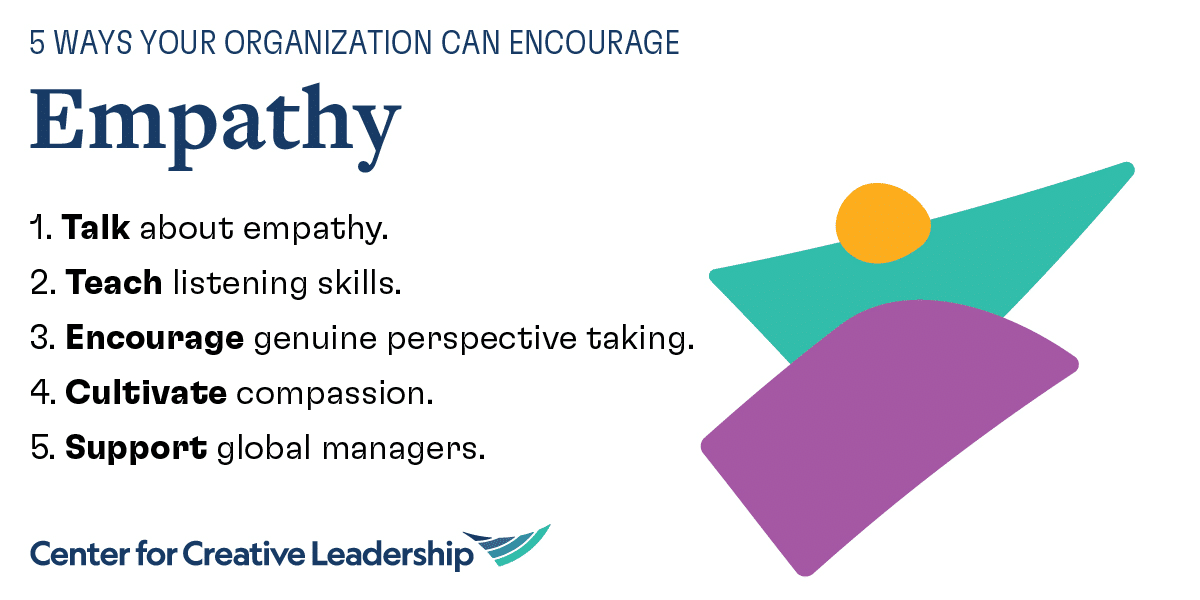
Let leaders know that empathy matters. Many managers consider task-oriented skills such as monitoring and planning to be more important in controlling the performance of their team members. But research shows that understanding, caring, and developing others is just as important, if not moreimportant, particularly in today’s workforce.
Explain that giving time and attention to others fosters empathy, which in turn enhances your performance and improves your perceived effectiveness.
To understand others and sense what they’re feeling, managers must be good listeners, skilled in active listening techniques, who let others know that they’re being heard and express understanding of concerns and problems.
When a manager is a good listener, people feel respected, and critical trust on the teamcan grow. To show the highest levels of empathy in the workplace, managers should focus on listening to hear the meaning behind what others are saying by paying attention to not only the words being said, but also the feelings and values being shown, through nonverbal cues such as tone, pace of speech, facial expressions, and gestures.
Managers should consistently put themselves in the other person’s place. For managers, this includes taking into account the personal lived experiences or perspectives of their employees. It also can be applied to solving problems, managing conflicts, or driving innovation. It’s very helpful to understand the role social identity plays for both yourself and others. In particular, empathy is an imperative for effective organizational diversity initiatives.
Support managers who care about how others feel, and consider the effects that business decisions have on employees, customers, and communities. Go beyond the standard-issue values statement and allow time for compassionate reflection and response. Remember, your employees care about social responsibility; your organization should too.
The ability of your middle managers to be empathetic leaders who can collaborate across boundaries is especially important for those working in global or cross-cultural organizations. Leading a multicultural team requires cultural intelligence and the ability to understand people who have very different perspectives and experiences.
And as the data we shared above shows, when managers hone their empathetic leadership skills, they improve their effectiveness and increase their chances of success in the job. Empathetic leaders are assets to organizations, in part because they are able to effectively build and maintain relationships and retain talent — a critical part of leading organizations anywhere in the world.
Model empathetic leadership and help your people develop greater empathy in the workplace with a customized learning journey for your leaders using our research-backed modules. Available leadership topicsinclude Boundary Spanning Leadership, Communication, Emotional Intelligence Training for Leaders, Listening to Understand, Psychological Safety & Trust, and more.

Bill Gentry, PhD
Former Director, Leadership Insights & Analytics and Senior Research Scientist
Leaders with a backbone are the ones who inspire others to follow their lead, who create a culture of innovation and excellence, and who drive change in the face of adversity. They have the courage to make tough decisions, the grit to do the hard work, and the confrontational tolerance to embrace conflict as a means of growth.

Leadership is the backbone of success. It is the guiding force that helps us navigate the rough waters of life, and it is the anchor that keeps us …
Leadership: The Backbone of Success

In a world filled with endless possibilities, opportunities are plentiful. However, it is the individuals who take action, seize these opportunities,…
Embracing the Mindset of a Proactive Opportunist: Unlocking Success and Personal Fulfillment
Those who fail to experiment with new ways of working are at risk of falling behind. And companies that figure out how to get distributed right will be able to take full advantage of the business opportunity it offers: teams that produce higher quality work, answer harder questions, and move faster.

New research shows return-to-office mandates are not only unpopular among workers, but also ineffective.
Well-executed distributed work makes for happier, more productive teams
Don’t be afraid to try new ideas, take the leap and embrace failure as a learning opportunity while your business constantly looks for ways to be innovative.

You and your business have to adapt your strategies, or the company will die.
Surviving The Shifting Tides: The Importance Of Innovative Business Approaches In Changing Times
What is the Johari window?
The Johari window is an exercise that helps you gain a better understanding of yourself and how others see you.

Discover traits you may not see in yourself by asking your team to participate in this illuminating personality assessment.
The Johari window: a fresh take on self-reflection

Are you opening your first business and launching it on the market? If so, then it’s important to understand that the first year is critical. Most …
4 Mistakes Startups Make In Year One.
Are you opening your first business and launching it on the market? If so, then it’s important to understand that the first year is critical. Most …
4 Mistakes Startups Make In Year One.

Can someone be a great leader and not be self-aware? I believe all great leaders are self-aware. If you don’t know how your behaviors affect others, …
The Self-Aware Leader: Take an Inside-Outside Approach
When you know the affect you have on others and how they perceive you, you can entertain different perspectives of a situation. You can be an inspiring leader. You are in a place of choice.



 Community Broker News and Views