It takes team alignment, emotional intelligence, psychological safety, intentional planning, healthy conflict, and some unifying rituals and routines. Put these pillars into play and your team will rise to the ranks of history’s most effective teams.
Explore the key factors that you must keep in mind to ensure that your marketing strategy is successful and does provide the demand as well as the support that you want for your business.
When you know the affect you have on others and how they perceive you, you can entertain different perspectives of a situation. You can be an inspiring leader. You are in a place of choice.
You can’t effectively manage people if you don’t cultivate genuine care for others.
As a people manager, you are no longer representing just your individual self. You represent your team and the team’s values and mission.
Task management becomes naturally easier if you create a culture of communication and accountability.
Putting people first means encouraging them to pursue their aspirations wherever they may lead – even if that means they must leave your team.
Managing people can be a deceptively simple task. Having experience as a “human skilled in craft” doesn’t necessarily make you a natural expert at leading other humans skilled in the same craft.
Team members interested in becoming managers seem to always ask me the same questions:
What did I experience while transitioning to a people-manager role?
What have I learned all these years?
What would I suggest individual contributors focus on to become better people managers?
Over the last nine years, some of my answers have changed and some have stayed largely the same. However, the most fundamental question aspiring people managers must ask themselves doesn’t appear on the list above.
Do you care about people?
I still remember February 2012. I’d finally found the courage to ask Archana Rao, my then-manager at Cisco (and Atlassian’s current CIO), what it would take for me to become a people manager.
“I see you to be really good at your craft and work,” she told me. “But are you good with people? Do you care about people? Or do you just want the title for other reasons?”
Her unvarnished honesty caused me to pause and think. If I wanted to be a leader, it wouldn’t be enough to care about the success of a project or the company, or even my own success. I would need to care about the people who depended on my leadership for THEIR success.
My people-management strategies and principles
Here’s how I channel the philosophy of that long-ago conversation into my current management practices.
1. Be a decision SHAPER, not a decision maker
After experimenting with with this idea over a few years, I have realized that teams work well when you invite them to shape a decision, not when you make a decision for them. This is one of the most important principles to me.
When I was studying at Stanford University, I learned about the “IKEA effect” as it relates to problem-solving. Like the affinity and attachment many harbor for the IKEA furniture they construct themselves, I learned that involving others in the decision-making process leads to the solution becoming their “baby.” Or put another way:
If you build a polished prototype others will see flaws. If you build a rough prototype, others will see potential.
Professor Baba Shiv, Stanford University
Shaping a decision involves asking the right questions and sharing examples and guidance – but not giving the answers. It may take time to get to the decision, but this approach improves the likelihood of the decision sticking, which, in turn, reinforces honoring commitments.
You can apply this in-person or through a DACI decision-making framework.
With decision-shaping, you’ll see that your team will begin to think about the impact not only on them, but on downstream teams, too. A good people manager will allow team members to arrive at the best decision, while being constructively critical in offering analysis and recommendations toward the decision.
Do note that my approach is centered on cultivating and motivating a team to arrive at a decision, not on manipulating them to make a decision I may favor.
2. Create a culture of accountability
Take every opportunity to promote accountability. While this takes effort to instill and reinforce, it will ALWAYS lead to improved trust and performance.
Back when I was a newbie people manager, I felt very uncomfortable when team members didn’t meet deadlines. Then, I would do their work in order to not let the stakeholders down.
The problem was obvious to my management coach who said, “Pranav, I understand it helps the stakeholders, but your team members are not learning to be accountable. Your role is to clear roadblocks, manage risks, and find the resources your team needs to manage its commitments.”
It actually took time to get used to NOT jumping in! What helped me make the transition was an accountability model that I set up for my team. I decided that, as a team, we needed to agree on being accountable. I developed the following rules that were easy to follow:
Think thoroughly before committing to a project and its dates.
Once you’ve committed, HONOR your commitments (or renegotiate the commitments if circumstances change).
I also discussed the attitudes and behaviors I expected. These open conversations led to less resistance from team members, while allowing them to demonstrate respect for each other.
3. Focus on people over tasks
Placing people over tasks not only results in better professional relationships, but powerful personal connections that can make work more meaningful – and even lead to strong friendships outside of work.
I learned to make an extra effort to know the individuals on my team as human beings, not just employees. We have regular 1:1’s and periodic lunch or coffee meetings. We even took walks when we were working in the office, which helped to promote relaxation and better communication on both sides.
I also became a better speaker by trying not to sound like I was complaining all the time.
But most importantly, I became a better listener.
By listening more, I found myself smiling more, and I felt genuinely interested. In short, I began to care more for what other people had to share! And I spoke a lot less about tasks!
4. Not everything will make it to production
Be sure your entire team understands the reason if a project doesn’t launch. They don’t need to agree, but they do deserve to know why.
Not all efforts lead to successful business outcomes. Priorities change, required efforts may have been underestimated, budgets get tightened, key skill-holders leave, or the anticipated ROI or business case can be incorrect.
This can negatively affect the team. Everyone likes to see their hard work result in something completed, no matter how minor. The antidote is to help your team understand WHY a project didn’t make it to production.
The best example I can share is from earlier in my career when I was still an IT architect. I worked on an initiative for multiple quarters with 50 other team members. It was bleeding edge, we’d already spent more than $10 million, and it was the heart of the project.
During testing, we realized a key element was not going to scale. Imagine the dread we faced. I was particularly affected because it was the first time I had to “pull the plug” and let a project die.
But as we were shelving it, we learnt that if we had not cut the cord, the initiative would have cost more than $10 million PER YEAR to maintain due to this major flaw. The lesson learnt was: a little pain now is worth avoiding much more later.
5. Saying no is ok, but…
One of the most frequent pieces of advice I have shared with newbie managers is that it’s OK to say no. But be prepared to share your logic.
One of my first 360-feedback sessions as a newbie manager revealed that while I was comfortable saying no, I was failing to provide reasons to team members and stakeholders. The result was they could not understand and appreciate my decisions. This affected trust!
Some managers feel threatened when they have to explain. But non-transparency generates questions about a manager’s leadership.
If necessary, try to write down your reasons. In fact, if you can’t write them down, perhaps you aren’t being thorough enough before saying yes or no.
6. “I” is “WE” now
As a people manager, you are no longer representing your individual self. You are now symbolic, representing your team and the team’s values and mission. It’s a great responsibility to be the embodiment of your people, their contributions, and their successes and failures.
We all hear that politics in the workplace is bad, but I’ve learnt that there is a difference between “Politics” – with a capital P – and “politics.”
Politics with a capital P, to me, means “organizational interests.” Whereas politics with a lowercase P can mean “self interest.”
As people managers, we have a duty to move away from the politics of self interest to the Politics of organizational interests.
People managers have to build the right guardrails for team success and, at the same time, be ready to own the effects of all the positive and negative outcomes. You are your team’s shield and banner.
So when you’re required to make decisions, you’re making them as a symbolic reflection of the team, its culture, and its values.
7. Be natural in your style
Aside from playing to our natural strengths, being natural in style is important. It takes less energy to be your true self than to appear as someone you’re not. And being natural can help you be vulnerable, which is an important leadership trait.
We all have natural strengths. I urge newbie managers to recognize theirs.
To stay in touch with my natural strengths, I use 360 feedback with my team, peers, and stakeholders. I also supplement feedback with psychological assessments like Instinctive Drives (my ID is 6337).
I’ve learned to be so comfortable sharing my areas of improvement that I’m OK asking for feedback and help with a behavior I may not want. Most importantly, I try to make these changes part of my subconscious way of working so that my natural style isn’t disrupted.
You will be more comfortable with all your team engagements by being natural, and it will definitely help you be sincere and honest when you have hard conversations.
8. Hire unconventional talent
Aside from traditional candidates with requisite technical skill sets, I also seek teammates who may not fit the traditional mold but who bring a growth mindset – they demonstrate curiosity, they’re open-minded toward industry breakthroughs, and have an eagerness to innovate – even if their technical skills need development.
As I see it, the rapid pace of technological change means we need some team members who are more versatile, have non-traditional viewpoints, and aren’t hyper-focused on a particular technology “religion.”
The additional energy and learning curves to get an unconventional new hire up to speed often prove to be worth the investment, and can yield a huge positive impact with respect to diverse viewpoints and out-of-the-box problem solving.
9. Attrition will happen
Sometimes you will not be able to support your team members’ career aspirations. Other times, they may simply need a change in challenge and work culture. Do not take these things personally.
If you’re putting people first, then you’re also encouraging them to pursue their aspirations wherever they may lead. If they are ready to move on, do your best to help them with internal mobility. This also aligns with being capital-P Political. Consider how their aspirations might align with the organization’s interests.
10. Celebrate failure
Create conditions so that team members feel open to making mistakes and admitting vulnerabilities, with the intention of turning mistakes into opportunities for group learning. Then CELEBRATE!
In a culture like Atlassian’s that strongly encourages risk and innovation, I cannot stress celebrating failure enough.
The best way to instill this principle is by talking about your own mistakes in detail and what you have learned.
While it helps to exploit current strengths, it is equally important to explore new things, make mistakes, and learn from them. Share stories of failure and discuss what the group learned. In fact, find a way to celebrate failures by celebrating whatever risks and innovations come out of the effort.
All failures qualify. It can be a failed experiment, a failure in hiring the right talent, even operational failures that require you to work hard for the cause and the fix.
To scale and become a high performing team, you not only need caring and sharing, you need daring. And all dares come with a huge chance of failure. Get comfortable with that.
Situational leadership takes a contextual approach to leadership.
In this model, leaders vary their approach based on an individual’s level of competence in a particular area.
Depending on the circumstances, a leader may choose to take a more directive or more supportive approach.
These days, it’s not uncommon to hear people obsessively talking about what “type of leader” they are. People are hungry for resources that will solidify their understanding of these archetypes. But obsessing over finding the right management style can be a dead end; not only are certain methods outdated, but there’s no single tool that will work in every situation.
If you want to build an effective, high-performing team that will stay relevant for years to come, situational leadership is the way to do it.
What is situational leadership?
Situational leadership is an adaptive leadership style in which a leader changes their approach based on the individual, the task, and the context.
Situational leadership theory changes the conversation from “Who am I and how do I lead?” to “Who is the person in front of me, and what do they need from me in order to be successful?”
Blanchard and Hersey call on the situational leader to utilize a framework that relies on flexibility, adaptability, and thoughtful analysis of what people need to develop and succeed. By letting context inform what an appropriate leadership style looks like in each situation as it occurs, leaders are able to take a nuanced approach to their responsibilities
4 examples of how to use situational leadership
Situational leadership is built on the idea that teams or individuals will be at different developmental levels in different areas of their job. Based on that context, leaders can adjust their approach to help individuals develop specific skills based on that person’s unique needs and area of work.
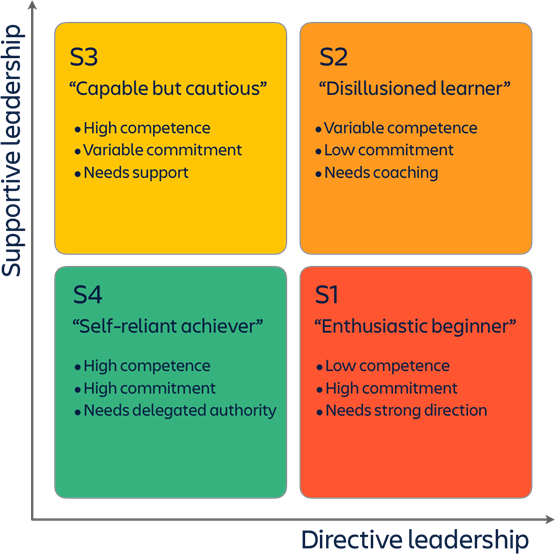
Situational leadership defines four development levels, paired with four behaviors, as a way of understanding a person’s growth and what is required from a leader to help them move forward. None of these behaviors is the “best,” because all of this is about taking a situational approach. Let’s take a look at each one.
1. The enthusiastic beginner
This is where almost everyone starts when they’re learning a new role or skill. Their commitment is high because there hasn’t been any experience that would challenge it, and their competence is low because they have little-to-no experience.
People don’t know what they don’t know. When an employee or teammate is learning something new, the best leadership for them will be highly directive. They don’t need to be encouraged that they can do it, as much as they need to be told what to do. This isn’t demeaning, it’s just the reality of starting to learn something new.
2. The disillusioned learner
When employees are at the disillusioned learner level, they’ve probably run up against their shortcomings in the competency they’re trying to gain. This experience of failure or inadequacy, coupled with only marginally increased competence, can be incredibly deflating.
As a person is confronted with the shortcomings in their proficiency, the natural reaction is to become discouraged. If you perceive that shift in your direct report, it’s essential that you add highly supportive behavior while maintaining a highly directive posture. The critical mistake leaders make in this stage is to think that because the person has been working at a skill that they no longer need direction. However, this is actually the stage where highly directive behavior is most important.
3. The capable-but-cautious performer
At this level, the employee starts to turn a corner. As their competence increases, often people will start to move out of that low-commitment funk.
This is a critical transition, according to situational leadership theory. As someone’s competence makes meaningful progress and their commitment level increases again, it’s important to scale back the level of direction you provide while maintaining a highly supportive environment.
4. The self-reliant achiever
At this point, the developing employee has reached a point of mastery in the skill they were learning. They can perform at a high level and feel confident about the quality of their contributions.
If a self-reliant achiever is a pro at what they’re doing, inundating them with tons of direction or smothering them with check-ins will most likely backfire. It’s a waste of your time, and takes their focus away from the thing they’ve become really great at. Managers of self-reliant achievers should focus on delegating tasks more than supporting their work.
Good leaders take different behavioral approaches to each of these developmental levels because what each level requires to succeed is different. There is no one-size-fits-all approach to leadership, and you should be suspicious of anyone who claims otherwise.
High-functioning teams are supported by leaders who focus on the practical needs of the people they’re leading and offer support specific to the areas where their team is stuck. Smart managers, practicing situational leadership, give their teammates exactly what they need, when they need it.
This past weekend, I had the opportunity to join my fellow board members of the Salvation Army of Greater Cleveland Advisory Board in West Cleveland as volunteer bell ringers supporting the Salvation Army’s Advisory Board Kettle Day fund raising effort. It was inspiring to see so many philanthropic business and executive leaders rallying together as a team spending time supporting this important seasonal kindness program. The generosity of the public response was truly overwhelming encountering real people who have been touched by the Salvation Army’s support of communities in need.
Board Members Robert Shenton and Vince Liuzzi GCAS Advisory Board Kettle Day
Did you know… The Salvation Army of Greater Cleveland makes a positive impact in our community serving nearly 1 million hot meals to hundreds of thousands of hungry people, provides over 160,000 nights of shelter and emergency housing services to people without shelter in need of transitionary lodging. Thousands of children and families in need will receive Christmas gifts this year donated by generous people who donate to the many toy drives sponsored by good, charitable companies throughout our region. Emergency shelters are open safely caring for and taking in the homeless. Counseling and recovery centers provide much needed services and support for some of the most vulnerable people living in our community. Visit www.SalvationArmyCleveland.org to learn more.
Ringing the bell in West Cleveland
So you see, everyone has an opportunity and a role to take responsibility in helping others. Without question, I can tell you based on my experiences in business and in life, that “Doing the Most Good” actually feels the most good. Sharing personal time, talents and treasures with people who truly need and deserve our help and support is the very best gift I could offer people who are less fortunate than me.
Regardless of life’s struggles, sadness and extreme challenges, I am incredibly grounded and thankful to be helping others. This holiday season, I ask you to join me in supporting the great works of the Salvation Army, or the charitable organization of your choice. The community needs your support, and you too have much to share. What a better way to celebrate the goodness of the season than to help others in need to feel the help and support of someone who really does care.
Mobile banking company Varo Money, Inc. has announced the results of their #SwitchYourBank survey. The survey of more than 1,000 U.S. adults age 18+, conducted by Propeller Insights on behalf of Varo Money in April, determined what Americans most love about San Francisco, Los Angeles, Chicago, Philadelphia, and New York, where quality of life is highest for […]
Statistics show that 78% of business leaders rate employee retention and engagement as critical or important to the success of their business. Organizations are looking for new and different ways to understand and improve employee or team member engagement. Effective and meaningful, active employee engagement is truly a competitive differentiator for the high performing business.
Active employee engagement goes far behind an annual survey facilitated by human resources that companies use as a measurement for employee morale. It speaks to the culture an organization fosters, and its willingness to make the right investments within the environment benefitting much-loved employees. In a recent study by Deloitte, three key areas of strategic focus on employee engagement were identified: Lead and Develop, Attract and Engage, Transform and Reinvent. These three priorities go far beyond a typical survey “temperature check” followed by an executive summary turned into an action plan – many companies still call that an engagement program. Its en excellent study with rock solid conclusions and some pretty interesting tools and resources.
In past decades, Gallup and other leadership organizations have led the way around the concept of employee engagement program surveys. Employee engagement has in reality, been a topic companies have considered since the industrial revolution. These concepts were essentially rooted in the late 1800’s by an industrial engineer Frederick Taylor who was looking for ways to improve industrial efficiency. In his book “The Principles of Scientific Management” Taylor theorizes that four principles of scientific management center around the engagement of employees and how their attitude impacted productivity in the steel industry. It was ground breaking work for its time – but that was over 100 years ago!
Developing, enhancing and maintaining a high performing work environment is truly a complex issue to tackle. It blends an organization’s mission and values with its people, culture and performance. Once people join an organization, companies must continuously improve, redesigning and developing the work environment to make it more enjoyable and rewarding, making the employees happier and more productive. In today’s environment, companies need to update the way they look to engage employees. With the influx of younger workers and the proliferation of technology, organizations need to change the way they think about engagement making the workplace environment more flexible, modern, humane and enjoyable. Organizations must build an environment that is fun, meaningful, stimulating and rewarding to attract and retain high performing employees in today’s workforce.
Forward thinking companies truly understand the critical need to go beyond traditional engagement survey programs to create more productive and successful work environments. They design jobs, change the work environment, add benefits, invest in people and develop managers. New employees hired into these organizations are screened for culture and job fit to ensure success. Effective hiring, on-boarding, training and development programs have never been so important.
Josh Bersin Principal and Founder of Bersin by Deloitte was recently quoted in a recent study published by Forbes magazine stating, “Let’s change our thinking and move beyond the concept of engagement. If we really achieve the goal of making organizations “irresistible”, we can make work fun, meaningful and enriching for everyone.”
















 Community Broker News and Views
